



































How we chose reels for our test
We take comments from our readers very seriously (you should leave some at the bottom). One of the most common remarks about each of shootouts is, "I can't believe they didn't test
What makes a great saltwater fly reel?
Our testing has evolved a lot since the first time we did our 8-weight challenge. But, one thing hasn't changed; we started by asking ourselves one question: What makes a great saltwater reel? As we've grown in our testing, this question has gotten a lot more complicated. Fundamentally, we're still looking for the same things: a great drag, fast line pickup, light weight, and good ergonomics.The Winner

Best Buy

Recommended Reels
We felt that it would be unfair to the makers of some really great reels to be left out, so we've come up with a matrix of reels that are excellent and may fit your needs better than the CCF or Hydros if your preferences are a little different than ours.
Testing Procedure


Scoring
In order to prioritize what was most important, we changed our scoring a bit this year. We awarded double points in 5 key performance areas. All three of our key performance factors got double points. Here are the categories:Max Drag Strength
10 points Max drag is our hallmark test category. It's been with us since the beginning and is what differentiates us from other shootouts. It also differentiates reels in terms of technical performance. No one would drive a Ferrari if it topped out at 75 MPH. We view drag strength as the 'top-speed' in our test. That said, we wanted reels that had AT LEAST 8 lbs of drag, and we penalized reels that didn't meet this benchmark. We measured drag strength by tightening the reel to the tightest we could reasonably get it with our fingers, then attaching the reel to our UTM and averaging the force after the reel hit its peak (about 2 inches). The top reels had over 20lbs of drag, but it was the Abel SDS that was the Ferrari of this test topping out at over 25lbs of drag!! Winner: Abel SDSUsable Drag Strength - New for 2018
10 points While Max Drag is the mark of technical performance, Usable Drag Strength is the actual amount of usable drag that the reel has. It's the amount you could comfortably dial in while fighting a fish. We measured this by marking the max point (from above), and then dialing it back 1/4 turn EXCEPT when the reels had drags that were easy to turn all the way to the max drag point. A great example of this is the Hatch - it requires very little torque to set it all the way to max drag, and therefore 100% of its drag is usable. Winner: Hardy Fortuna XDSHalf Drag - New for 2018
20 points Sure, it's important to have a lot of drag, but it's equally (if not more) important to have a drag that's adjustable. Why have 2 turns of drag when the reel is going to free spool after one turn? For this category, we started with our Max Drag point, then dialed it back exactly half of the range of the drag. In an ideal world, we'd like to see exactly 50% of the drag at this point, but what we found was that drag force ranged from 2-62% of Max Drag. We awarded points based on how close reels got to 50%. Here's a graph that further illustrates why a linear drag is better than a non-linear one.
Free Spool - New for 2018
10 points Have you ever been out on the water when that big fish sneaks up on you just as you get to a spot? You turn down the drag to strip line off your reel as quickly as you can to make that critical first cast only to find that your neatly wound up line has been turned into a birds nest? Ok, maybe it's just me... What prevents a reel from free-spooling? Having enough drag to slow it down (or some other mechanism - more on that in the individual reviews). We were looking for about .4lbs of drag and surprisingly, no reels actually hit this. The best reels got pretty close on either top end or the bottom end. Winner: Orvis Hydros SLStart-up Inertia
20 points If you troll the fly fishing forums, there's a lot of talk about start-up inertia - and with good reason. But let's back up. What is start-up inertia? All drags work in essentially the same way - two plates create friction which slows the spinning of the spool. There are two types of friction: static - when the drag isn't moving - and kinetic - when a fish is pulling on the drag. Start-up inertia is the initial force required to get the drag started. So, it's actually a bit of a misnomer. It should actually be called "static friction". So... who cares? Because static friction is greater than kinetic friction, it causes a drop in drag force immediately after the fish starts pulling on your line. Here's what it looks like on a drag graph:
Arbor Size and Retrieval Rate
20 Points In terms of pure performance, retrieval rate is one of the most important and noticeable features of a fly reel. When a fish turns and starts swimming toward you, you need to reel as fast as you can to keep the fish on. It also means fewer turns to bring in that trophy or just reel up as you change spots. Therefore, bigger IS better, as they say. For those of you who don't know, the arbor refers to the mid-section of the spool. Think of the hole in the donut. Following the analogy, the larger the diameter of the hole, the larger the arbor. Almost all of the fly reels we tested claim to be "large arbor", but we discovered that there was quite a variation between reels. The 3-Tand TF-70 was the smallest at 1.8 inches. You could almost fit this entire reel through the arbor of the absolutely enormous Loop Opti Speedrunner. But what we really care about is line pickup, and, therefore, that's what we scored as part of the test. To get this, we needed to determine the circumference at .75 cubic inches. That's how much space 75 yards of 20lb Dacron backing takes up. The formula is:
Spool Width
10 points For many years, the trend in fly reel manufacturing was to make the arbors larger and the spools wider. Why? It helps keep the weight down and gives you a fast retrieval rate. This comes at a price, however, which is you having to act as a level wind every time you reel in your line so that the line doesn't pile up. This was disputed in another review, so if you'd like more information on narrow vs wide, check out this article. Winner: Hardy Ultralite MTXSpool Volume
10 Points Bigger reels are more flexible. They hold more line and give you more options – like being able to put a 9 or 10-weight line on an 8-weight reel. More importantly, you're never going to have to worry about line piling up on a reel that holds 200 yards of backing. We calculated estimated volume using the following formula:
Weight
20 points As fly fisherman, we've become obsessed with weight. Rods are pushing the limits, some weighing in at less than two ounces. Reels are getting lighter too. Why are lighter reels better? As rods get lighter, you need lighter reels to balance them. Moreover, when you're casting all day a lighter outfit is easier on your arms. If you make 100 casts in a day, every ounce works out to over 6 extra pounds you need to move. Winner: Waterworks-Lamson Force F3 SL IISound
10 points Sound is an important, yet often under appreciated, part of a fly reel. Drag sounds provide a lot of feedback when fighting a fish, which is useful, but they also add to the excitement of catching a fish that makes a great run. At Trident, we prefer reels that have both an incoming (when reeling in) and outgoing (when the fish is taking the drag) sound.Look & Feel
10 points We can talk about fly reel performance all day long, but when it comes down to buying a reel, look and feel is just as important. That's why top reel manufacturers offer dozens of custom colors and 100s of possible combinations. This is purely subjective, but there's unlikely to be many people who prefer the feel of a Redington over a Tibor. So, we gave you our opinions on the matter.Ergonomics
20 points We introduced ergonomics in our 5-weight shootout. Which is to say, how well is the reel designed from a human interaction standpoint. You interact with the reel at 3 key points: the handle, which you are in contact with most, the drag knob, which is used less frequently, but often requires quick and easy access, and the spool change, which is obvious. As all of the reels had quick change spools, we didn't bother evaluating it this time around. Handle: The best handles were fairly long - they move your knuckles further away from the spool so you're never touching it. They are also wide enough to be comfortable. Our favorite handle came from Nautilus. The CCF and the NV-G share a handle that's fantastic! Drag knob: When a fish is cruising into open water and you've left your drag wide open, nothing is more important that getting that adjusted back to a fishable level. Nautilus also won this one with the CCF sporting a knob that's not only large and easy to hold on to, but has a great texture to give you added grip.Finish (a.k.a. The Drop and the drag)
10 points

Price - changed for 2018
When we revisited our testing criteria this year, one of the toughest decisions was about whether or not we should include price, and if so, how many points should it get. This time around we landed on not including price. We found that it was distracting from the test and decided to let you make your own decisions on value.The Results

The Raw Data


Reel Notes and Drag Strength Graphs
| 1. Nautilus CCF-X2 8/10 |  |
| 2. Orvis Mirage USA IV |  |
| 3. Hatch Gen 2 Finatic 7 Plus |  |
| 3. Ross Evolution R Salt 9/10 |  |
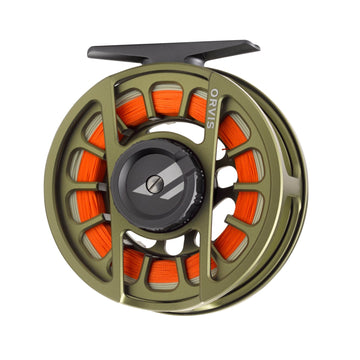
| 5. Orvis Hydros SL IV |  |
| 6. Nautilus CCF-X2 6/8 |  |
| 6. Ross Evolution R Salt 7/8 |  |
| 6. Abel SDS 7/8 |  |
| 9. Einarsson Invictus 8/10 |  |
| 10. Galvan Grip 8 |  |
| 10. Hardy Fortuna XDS 6000 |  |
| 12. Nautilus NV-G 7/8 |  |
| 13. Waterworks Force F3 SL II |  |
| 14. Bauer RX5 |  |
| 14.Nautilus NV-G 8/9 |  |
| 16. 3-Tand TX-80 |  |
| 16. Sage Spectrum LT 7/8 |  |
| 18. Lamson Litespeed Micra 5 3.5 |  |
| 18. Sage Spectrum Max 7/8 |  |
| 20. Taylor Revolution 7-9wt |  |
| 21. Loop Opti Speedrunner |  |
| 22. Sage 2280 |  |
| 22. 3-Tand V-80 |  |
| 24. Nautilus XL Max |  |
| 25. Hardy SDSL 6000 |  |
| 25. Hardy Ultralite MTX 7000 |  |
| 27. Loop Opti Strike |  |
| 28. Redington Behemoth 9/10 |  |
| 29. Islander LX 3.8 |  |
| 30. Sage Spectrum 7/8 |  |
| 30. Loop Evotec HD 8ten |  |
| 32. Taylor Array 8/9/10 |  |
| 33. Abel Super 7/8 |  |
| 34. Taylor Enigma ESD 6-8 |  |
| 35. 3-Tand TF-70 |  |
| 36. Einarsson 8Plus |  |
| 37. Cheeky Boost 400 |  |
Ready to Buy? Shop at Trident Fly Fishing
We're a full-service fly shop - your purchase directly supports the reviews and content you just read.
Comments
(0)No comments yet. Be the first!